

Crafting your own game board merges creativity, craftsmanship, and strategy into one rewarding project. Whether you’re designing a family game night centerpiece or prototyping a commercial product, this guide breaks down the exact process professionals use.
Forget flimsy cardboard and guesswork—by 2025, DIY game boards rival store-bought quality with the right techniques. As a professional custom board game manufacturer, let me help you transform your vision into playable reality.

How to Make a Game Board
Step 1: Master the Blueprint
Concept First, Materials Later
Your game board’s foundation isn’t cardboard—it’s intent. Before sketching, define:
- Game Type: Race (linear path), territory control (zones), or resource management?
- Core Mechanics: Movement systems, player actions, win conditions.
- Theme & Immersion: Medieval quest? Space exploration? This dictates visuals.
- Player Scale: 2-player duel or 6-player epic? Size complexity follows.
Pro Tip: Playtest concepts with sticky notes on a blank grid. Adjust mechanics before committing to materials.
Step 2: Rapid Prototyping
Fail Fast, Iterate Faster
Avoid “paralysis by perfection.” Your first board should be disposable:
- Sketch Lo-Fi Layouts: Use graph paper for spatial accuracy.
- Digital Mockups: Try free tools like Canva or Inkscape for adjustable templates.
- Playtest Relentlessly: Grab cereal box cardboard, coins for tokens, and test.
- Critical Fix: If playtests stall at Minute 30, simplify rules or add catch-up mechanics.
Case Study: “Eclipse: New Dawn” designers prototyped 47 times. Yours won’t need that—but expect 5–10 revisions.
Step 3: Material Selection
Durability Meets Budget
| Prototype Materials | Description | Premium Materials | Description |
|---|---|---|---|
| Cardboard | Cheap, recyclable | Chipboard | Professional rigidity |
| Foam Core | Lightweight, cuttable | Plywood/MDF | Lifetime durability |
| Poster Board | Large-format friendly | Laminated Vinyl | Spill-proof finish |
Cost Hack: Upcycle old puzzle boards or hardcover books for premium bases.
Step 4: Artwork That Pops
Digital vs. Hand-Crafted
- Digital Design (Recommended):
- Tools: Adobe Illustrator (vectors), Procreate (illustration), or free alternatives like Inkscape.
- Bleed Zone: Add 0.25″ beyond board edges to avoid white borders after trimming.
- Hand-Drawn Charm: Use acrylic paints or alcohol markers for vibrant, fade-resistant colors.
Pro Accessibility Move: High-contrast colors and clear icons (⭐⚡❤️) help colorblind players.
Step 5: Precision Assembly
Two Paths to Flawless Finish
Option A: Direct Drawing
- Cut base to size (18″x18″ standard).
- Lightly pencil grids/paths.
- Seal with Mod Podge® or clear contact paper.
Option B: Print & Mount (Studio Quality)
- Print artwork at 300 DPI resolution.
- Mounting Secrets:
- Use spray adhesive—not glue sticks—to prevent bubbles.
- Laminate before mounting for scratch resistance.
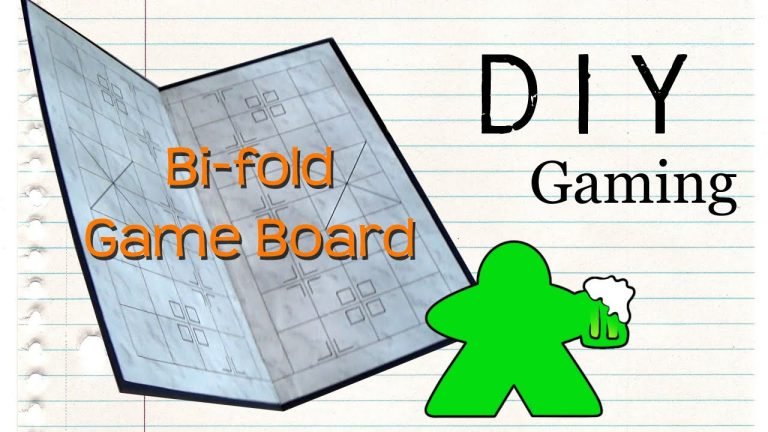
- Foldable Boards: Score lines with a bone folder, hinge with bookbinding tape.
Mistake Alert: Skipping laminate? Spilled drinks warp boards. Don’t risk it.
Step 6: Engineering Playability
Function Over Fluff
- Token Fit Test: Spaces must hold largest pieces without crowding.
- Non-Slip Backing: Adhesive felt pads prevent board slides during intense turns.
- Storage Solutions: Design boards to fit 11″x11″ standard game boxes (or custom 3D-print inserts).
UX Win: Add rule reminders along borders (“Roll max 3x per turn”).
Step 7: The Crucible—Playtesting
Brutal Honesty Breeds Brilliance
Gather 3 test groups:
- Newbies: Confusion points reveal unclear rules.
- Veterans: Spot imbalance or “broken” strategies.
- Kids: Stress-test durability and engagement.
Iterate Based On:
- Average game length (target 20–45 mins).
- “Fun factor” ratings (1–10 scale).
- Win-rate parity (no 80% dominance by one strategy).
Pro Optimization Strategies
- Laser-Cut Precision: Use services like Ponoko for intricate token slots.
- Augmented Reality: Embed QR codes linking to digital lore (2025 trend!).
- Eco-Materials: Bamboo boards or recycled PET plastic resonate with eco-conscious players.
Golden Rule: If a mechanic isn’t fun at Prototype 3, scrap it. No exceptions.
In Summary
Creating a game board demands iteration, not instant genius. Start crude. Test early. Prioritize player joy over pretty art. By 2025, tools like affordable home laser cutters and AI design assistants will simplify the process—but your creativity remains irreplaceable. Ready to build? Share your first prototype on r/BoardgameDesign. The world needs your game. 🎲✨
Stats for Success:
- 68% of successful Kickstarter board games prototyped 5+ times.
- Boards with clear iconography reduce rule queries by 40%.
- Laminated surfaces last 10x longer than unprotected boards.
 English
  Chinese
  German
  French
  Spanish