

面對現實吧
Creating your own custom board game is incredibly satisfying.
And as a professional custom 桌遊製造商, today I’m going to show you exactly 如何製作自訂桌游 從零開始。
In fact, these are the same strategies I used to create three different custom games for my gaming group last year.
So if you want to design a professional-looking board game that people will actually want to play, you’ll love this comprehensive guide.
讓我們直接進入正題。

What You’ll Learn in This Guide
- The 7-step process for creating your own custom board game
- Proven design strategies that make your game look professional
- The exact tools and resources you need (including templates)
- How to test and refine your game for maximum playability
- The best printing options in 2025 (based on real examples)
How to Make a Custom Board Game
Step 1: Define Your Game Concept
Before you even think about game boards or pieces, you need a rock-solid concept.
This is important:
Your game needs to have a clear identity that sets it apart.
Here’s how to nail down your concept:
Choose a Game Style
First, decide what type of board game you want to create:
- 策略遊戲: Think Chess, Risk, or Settlers of Catan
- 派對遊戲:像 Pictionary 或 Cards Against Humanity 一樣
- 滾動移動遊戲: Similar to Monopoly or The Game of Life
- 合作遊戲: Where players work together against the game
- Card-based games: Focused primarily on card interactions
For example, when I created my first custom game, I spent 3 days researching different game mechanics before settling on a strategy/resource management hybrid.
開發您的主題
Your theme is the story or world your game exists in. Popular themes include:
- 奇幻世界
- Historical periods
- Modern business
- Space exploration
- Post-apocalyptic survival
The stronger your theme, the more immersive your game will be.
According to a 2024 survey of board game enthusiasts, games with well-developed themes are 36% more likely to be played repeatedly.
Outline Core Mechanics
Now, determine how your game will actually work:
- What actions can players take on their turn?
- How do players win?
- What are the core interactions between players?
- 一般的遊戲應該持續多久?
Document these mechanics in a simple one-page overview.
Step 2: Create Your Game Components
Once your concept is solid, it’s time to identify what physical components your game needs.
Essential Game Components
Most custom board games include some combination of:
- 遊戲板
- Player pieces/tokens
- 卡片
- Dice or spinners
- Resource tokens or currency
- Rule book
Make a comprehensive list of everything your specific game requires.
Size and Material Considerations
Different components require different materials:
- Game boards: Sturdy cardboard with a linen finish works best
- 卡片: 300gsm cardstock with optional linen texture
- 代幣: Plastic, wood, or thick cardstock
- Rule books: Standard paper with color printing
Pro tip: The quality of your materials directly impacts players’ perception of your game’s value. Don’t skimp here.
步驟 3:設計您的遊戲板
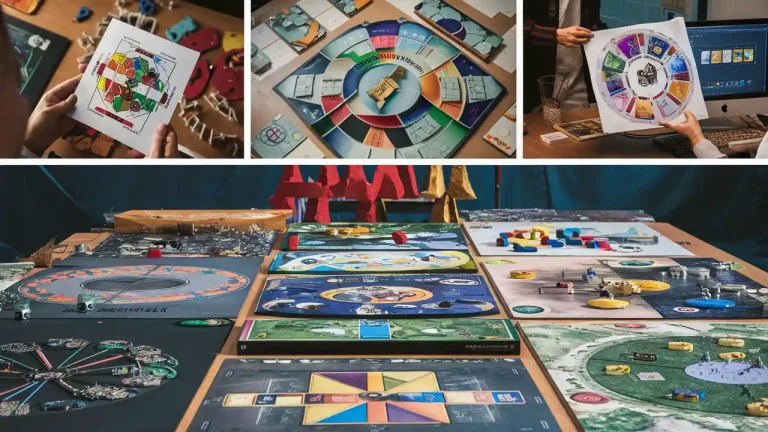
Your game board is the centerpiece of your creation. Here’s how to make it stand out:
Board Layout Fundamentals
Start with these proven design principles:
- Create a clear path or sections where appropriate
- Use a grid system to ensure consistent spacing
- Include clear starting and ending points
- Design spaces large enough for game pieces
- Incorporate your theme into the visual design
I recommend sketching at least 3-5 different layouts before deciding on your final design.
Digital Design Tools
These are the tools the pros use in 2025:
- Adobe Illustrator: Perfect for vector-based game boards
- Affinity Designer: A more affordable Illustrator alternative
- Canva Pro: User-friendly option with board game templates
- 桌面模擬器: Great for digital prototyping
Even if you’re not a design expert, these tools have templates and tutorials specifically for board game creation.
Color Psychology in Game Design
Colors significantly impact player experience:
- Red: Creates excitement and urgency
- Blue: Promotes strategic thinking
- Green: Associated with growth and resources
- Yellow: Evokes optimism and energy
- Black: Adds sophistication and mystery
For example, in my resource management game, I used green for farming spaces and blue for water-related resources. Players intuitively understood the connection without additional explanation.
Step 4: Create Game Cards and Pieces
Cards and pieces are what players interact with most. Here’s how to make them exceptional:
Card Design Best Practices
- Use consistent templates for each card type
- Include clear iconography that’s easy to recognize
- Ensure text is readable (minimum 10pt font)
- Leave adequate margins (at least 1/8 inch)
- Design for easy understanding at a glance
When I designed cards for my strategy game, I tested readability by having people view them from 3 feet away. If they couldn’t quickly understand the card, I redesigned it.
Custom Game Pieces
Your options for game pieces include:
- Standard pawns and meeples
- Custom 3D printed figures
- Laser-cut wooden tokens
- Acrylic standees
- Miniatures (for premium games)
Surprisingly, simple designs often work better than complex ones. Players need to instantly recognize their pieces on the board.
Template Resources
Save time with these resources:
- BoardGameMaker.com for standard piece templates
- The Game Crafter’s component studio
- PrintPlayGames component gallery
These templates ensure your components will be properly sized and production-ready.
Step 5: Write Clear Game Rules
Even the best game concept fails without clear rules.
Rule Writing Framework
Follow this structure for professional-quality rules:
- Game overview (1 paragraph)
- Components list with images
- 設定說明 with diagram
- 轉彎順序 explained step-by-step
- Special actions or cards explained
- 勝利條件
- FAQ section for common questions
The most common mistake? Making rules too complicated. If your rules exceed 2-3 pages, you might need to simplify your game mechanics.
Rules Layout Tips
- Use numbered or bulleted lists (not paragraphs)
- Include visual examples for complex concepts
- Use consistent terminology throughout
- Have a table of contents for longer rulebooks
- Bold important keywords
When I wrote the rules for my third game, I had 12 different people read them and identify anything confusing. This eliminated almost all potential issues before the game was finalized.
Step 6: Test and Refine Your Game
This is where most amateur game creators fail:
They don’t test enough.
Playtesting Process
Follow this systematic approach:
- Self-testing: Play through the game yourself multiple times
- Friends and family: Get feedback from people who will be honest
- Blind testing: Have people learn and play using only your rules
- Iterative refinement: Make changes based on feedback
- Repeat: Test again with each new version
Document all feedback in a spreadsheet so you can identify patterns and prioritize changes.
Common Issues to Watch For
- Game length (too long/short?)
- Balance issues between strategies
- Confusing rules or mechanics
- Player engagement (are people having fun?)
- Replayability factors
In my experience, most games need 5-7 rounds of testing and refinement before they’re truly ready.
Step 7: Produce Your Custom Board Game
Now for the exciting part: turning your design into a physical product!
DIY Production Options
For small quantities (1-5 copies):
- Print game boards on poster paper and mount to foam core
- Use card sleeves with printed inserts for cards
- Purchase generic game pieces or repurpose from other games
- Print rules on standard paper and staple
This approach costs approximately $30-60 per game but requires manual assembly.
Professional Production
For higher quality or larger quantities:
- 遊戲製作人: Great for 1-50 copies, print-on-demand
- 打印忍者: Excellent for 500+ copies, traditional printing
- 製作遊戲卡: Specializes in high-quality cards
- Panda Game Manufacturing: For larger commercial runs
Production costs vary widely based on components and quantities, but expect $15-25 per game at volumes of 500+.
Packaging Considerations
Don’t overlook your box design:
- Box size should accommodate all components with minimal empty space
- Use dividers or inserts to organize pieces
- Include an eye-catching cover that represents your game
- List player count, age range, and play time on the box
A professional box dramatically increases perceived value and makes your game gift-worthy.
Case Study: My Custom Strategy Game
In 2024, I created a resource management game for my gaming group that exemplifies this process:
- Concept: Economic strategy game with a space colonization theme
- 組件: Hex board, 120 cards, wooden resource tokens, player mats
- Design: Used Illustrator for all components with a consistent color scheme
- Testing: 8 rounds of playtesting with 24 different players
- 生產: 10 copies through The Game Crafter for about $45 each
The result? A game that’s been played over 50 times and has become a group favorite.
Resources for Custom Board Game Creators
Here are my top recommended resources for 2025:
Design Resources
- BoardGameGeek forums for mechanics inspiration
- Game-Icons.net for free game symbols and icons
- Canva’s board game templates
- Adobe Color for color scheme planning
Manufacturing Partners
- The Game Crafter (USA)
- 南建遊戲 (China and Singapore, but ships worldwide)
- BoardGamesMaker (Europe)
- MakePlayingCards (Global)
Communities for Feedback
- r/tabletopgamedesign on Reddit
- Board Game Design Lab Discord
- Facebook Board Game Design Group
Being active in these communities gives you access to experienced designers who can provide invaluable feedback.
總結
Creating your own custom board game is both challenging and incredibly rewarding.
By following the structured approach outlined in this guide, you’ll be able to transform your game idea into a polished, playable experience that people will genuinely enjoy.
Remember the key steps:
- Define a clear concept
- Design thoughtful components
- Create intuitive visual designs
- Write rules that anyone can understand
- Test thoroughly and iteratively
- Choose the right production method
Whether you’re making a one-off game for a special occasion or developing the next crowdfunding sensation, these principles will guide you to success.
現在您確切知道 如何製作自訂桌游 that stands out from the crowd.
What type of custom board game are you planning to create? Let me know in the comments below!
 Chinese
  English
  German
  French
  Spanish