
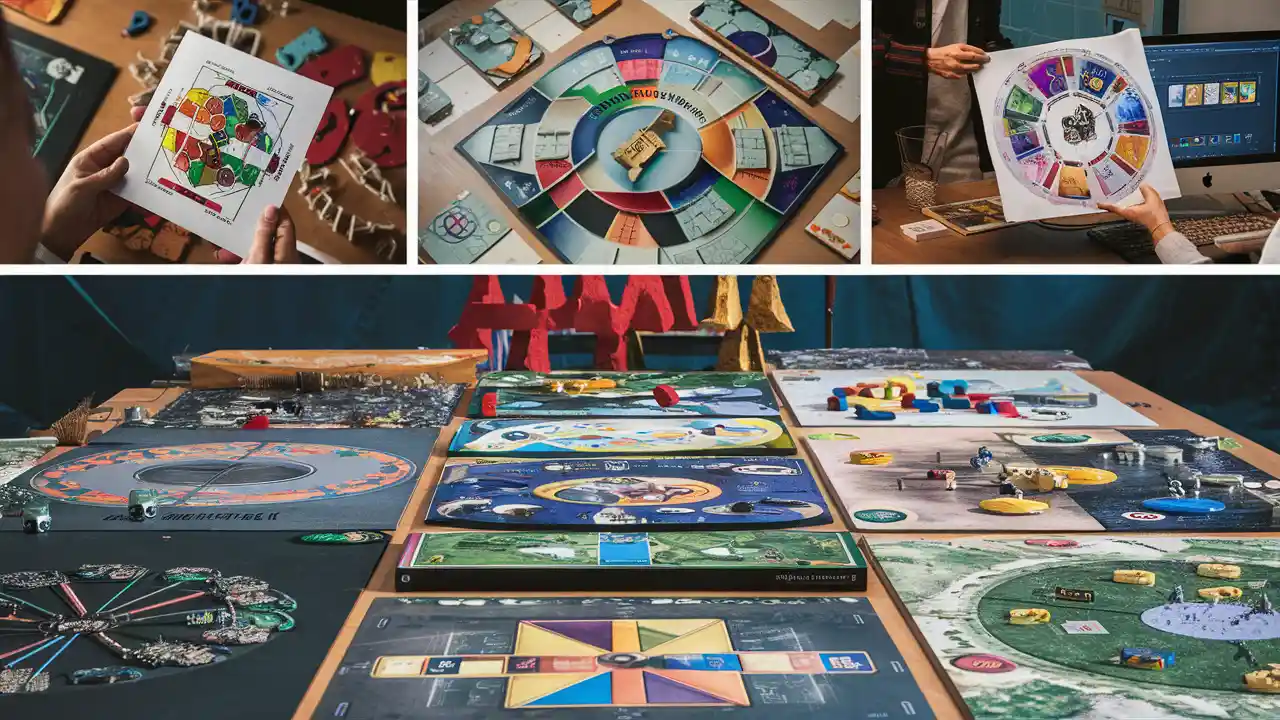
Have you ever dreamed of holding your own board game in your hands?
Maybe you’re a designer with the next big tabletop hit. Or perhaps you’re planning a corporate event and want something totally unique.
So sieht es aus: individueller Druck von Brettspielen has never been easier (or more affordable) than it is right now.
But there’s a catch.
With so many printing options, services, and technical requirements, it’s easy to make costly mistakes that’ll leave you with a game that looks… well, amateur.
The good news? I’ve spent years researching this industry. And in this guide, as a professional custom Brettspielhersteller, I’m going to show you exactly how to navigate the world of custom board game printing like a pro.
Klingt gut? Tauchen wir ein.

What is Custom Board Game Printing?
Custom board game printing is the process of manufacturing a board game tailored to your specific vision and requirements.
Unlike grabbing a game off the shelf at Target, custom printing gives you complete control over:
- Game components (boards, cards, tokens, dice)
- Materials and finishes
- Artwork and design
- Box packaging
- Regelbücher
The bottom line? You’re creating something that’s 100% yours.
But here’s where it gets interesting…
The custom printing industry has exploded in recent years. According to industry reports, the global board game market is expected to reach $30 billion by 2025.
That means more printing services, better technology, and (most importantly) lower costs for creators like you.
Print-on-Demand vs. Bulk Manufacturing: Which Path Should You Take?
This is probably the biggest decision you’ll make in your printing journey.
Let me break down your two main options:
Print-on-Demand (POD)
Perfekt für:
- Prototypes and testing
- Small batches (1-500 copies)
- Personal projects
- Crowdfunding campaigns
Vorteile:
- Keine Mindestbestellmengen
- Lower upfront costs
- Quick turnaround times (5-10 business days)
- Easy to make changes between orders
Nachteile:
- Higher per-unit costs ($8-25 per game)
- Limited material options
- Less customization flexibility
Bulk Manufacturing
Perfekt für:
- Commercial products
- Large orders (1,000+ copies)
- Retail distribution
- Established games
Vorteile:
- Much lower per-unit costs ($2-8 per game)
- Premium material options
- Full customization control
- Professionelle Qualität
Nachteile:
- High minimum orders (usually 500-1,000+ pieces)
- Larger upfront investment
- Longer production times (3-8 weeks)
- Setup costs for each component
Pro Tip: Most successful game creators start with POD for prototyping, then move to bulk manufacturing once they’ve proven demand.
The Essential Components: What You Need to Know
Here’s where things get technical (but don’t worry, I’ll keep it simple).
Your game likely includes several components. And each one has specific requirements:
Game Boards
Your board is the centerpiece of your game. Here are the most popular options:
Folding Boards:
- 1.5mm Grey Chipboard: Budget option ($2-4 per board)
- 2.0mm Grey Chipboard: Standard choice ($3-6 per board)
- Mounted Boards: Premium option ($5-10 per board)
The thickness matters more than you think. A 2.0mm board feels substantially more premium than 1.5mm.
Game Mats:
- Neoprene: Flexible and durable
- Vinyl: Budget-friendly but less durable
- Fabric: Premium feel but more expensive
Karten
Cards are probably the most technical component to get right.
Cardstock Options:
- 300gsm Blue Core: Industry standard ($0.08-0.15 per card)
- 330gsm Premium: Enhanced durability ($0.12-0.20 per card)
Finish Options:
- Smooth: Clean look but shows fingerprints
- Linen: Better grip and wear resistance (+$0.02-0.05 per card)
- Matte: Reduces glare
- Glossy: Makes colors pop
Here’s something most people don’t know: the “blue core” in cardstock prevents light from showing through your cards (which could reveal information to other players).
Tokens and Game Pieces
This is where you can really make your game stand out:
Chipboard Tokens:
- 2mm thickness: Standard option ($0.15-0.30 per token)
- Custom shapes: Additional die-cutting charges apply
Wooden Components:
- Meeples: $0.08-0.25 each
- Cubes: $0.05-0.15 each
- Custom shapes: Require specialized tooling
Plastic Components:
- Injection molded: Premium but requires high minimums
- 3D printed: Great for prototypes and small runs
Custom Dice
Standard dice are cheap. Custom dice? That’s where things get interesting.
Die Optionen umfassen:
- Engraved wooden dice
- Custom plastic dice with unique symbols
- Metal dice for premium games
But here’s the thing: custom dice usually require minimum orders of 100+ pieces per design.
File Preparation: Getting Your Artwork Print-Ready
This section could save you hundreds (or thousands) of dollars in reprints.
Because here’s what most first-time creators don’t realize: print shops receive files every day that simply can’t be printed.
Resolution Requirements
Everything needs to be 300 DPI minimum.
I can’t stress this enough. That beautiful artwork you created at 72 DPI for your website? It’s going to look pixelated and amateur when printed.
Color Mode: CMYK vs. RGB
Your computer screen displays colors in RGB. Printers use CMYK.
If you design in RGB and don’t convert to CMYK, your colors will shift during printing. That bright red might become a muddy brown.
Bleed Areas
Include a 3mm bleed area around all artwork.
Why? Because cutting isn’t perfectly precise. Without bleeds, you might end up with white edges on your components.
File Organization Pro Tips
Here’s how I recommend organizing your files:
GameName_ProjectFiles/
├── Boards/
│ ├── GameName_Board_Front_v2.pdf
│ └── GameName_Board_Back_v2.pdf
├── Cards/
│ ├── GameName_Cards_Front_v3.pdf
│ └── GameName_Cards_Back_v3.pdf
├── Tokens/
│ └── GameName_Tokens_v1.pdf
└── Box/
├── GameName_BoxTop_v1.pdf
└── GameName_BoxBottom_v1.pdf
Use consistent naming conventions. Your printer (and future you) will thank you.
Top Custom Board Game Printing Services in 2025
After researching dozens of companies, here are the ones I recommend:
Der Spiele-Crafter
Geeignet für: Prototypes and small runs
Why I like them:
- No minimum orders
- User-friendly online interface
- Built-in marketplace to sell your games
- Transparente Preisgestaltung
Typical costs: $12-25 per game for small quantities
BoardGamesMaker
Geeignet für: Custom components and mid-size runs
Why they stand out:
- Wide range of component options
- 3D printed miniatures available
- No minimum orders
- Good customer service
Typical costs: $10-20 per game
PrintNinja
Geeignet für: Large-scale production and premium quality
Why I recommend them:
- US-based with excellent communication
- High-quality offset printing
- Competitive pricing for bulk orders
- Great for crowdfunding campaigns
Typical costs: $3-8 per game for 1,000+ copies
Nanjian Spiele
Geeignet für: International production and cost savings
Why they’re worth considering:
- Very competitive pricing
- Handles complex components well
- Good for large orders (1,000+ minimum)
- Comprehensive manufacturing services
Typical costs: $2-6 per game for large quantities
But here’s the thing: pricing varies dramatically based on your specific requirements.
Always get quotes from multiple services before making a decision.
Cost Breakdown: What You’ll Actually Pay
Let me give you some real-world examples:
Scenario 1: Simple Card Game (100 copies via POD)
- 54 standard cards: $5-8
- Rules booklet: $1-2
- Tuck box: $2-3
- Total per game: $8-13
Scenario 2: Standard Board Game (500 copies via bulk)
- Game board (folding): $3-5
- 100 cards: $4-6
- 50 wooden tokens: $3-5
- Game box: $2-4
- Rule book: $1-2
- Total per game: $13-22
Scenario 3: Premium Game (2,000 copies via offset)
- Mounted game board: $2-3
- 150 cards with linen finish: $3-4
- Custom wooden meeples: $2-3
- Premium box with insert: $3-4
- Full-color rule book: $1-2
- Total per game: $11-16
The bottom line? Economies of scale are real in board game printing.
Hidden Costs Most People Forget
Here are the expenses that often catch first-time creators off guard:
Shipping Costs
This can be 10-25% of your total print cost, especially for international orders.
For a 500-game order from China, expect shipping costs of $300-800 depending on:
- Weight and dimensions
- Shipping method (sea vs. air)
- Current shipping rates
Import Duties and Customs
If you’re importing games, budget an additional 5-15% for duties and customs fees.
Storage and Fulfillment
Where are you going to store 1,000 board games? And how will you ship them to customers?
Many creators use fulfillment services, which typically charge:
- Storage: $0.50-2.00 per unit per month
- Pick and pack: $2-5 per order
- Shipping materials: $1-3 per order
Damaged Inventory
Budget 2-3% for damaged copies. It’s going to happen.
Quality Control: Avoiding Costly Mistakes
Here’s something I learned the hard way: always order a physical proof before your full production run.
Digital proofs look great on screen. But they can’t show you:
- How the materials actually feel
- Whether colors match your expectations
- If text is readable at actual size
- How components fit together
Most quality issues I see fall into these categories:
Color Problems
- Colors that look different than expected
- Inconsistent colors between components
- Text that’s hard to read due to poor contrast
Cutting Issues
- Components that don’t fit properly
- Rough or uneven edges
- Misaligned artwork
Material Problems
- Cards that feel flimsy or cheap
- Boards that warp or bend
- Tokens that chip easily
Pro Tip: If you’re working with a new printer, order a small test run first. Better to discover problems with 50 copies than 5,000.
Sustainable and Eco-Friendly Options
More creators are asking about environmentally responsible printing options.
Here’s what’s available in 2025:
FSC-Certified Materials
Papers certified by the Forest Stewardship Council cost about 5-10% more but come from responsibly managed forests.
Soy-Based Inks
Most modern printers use soy-based inks by default. They’re better for the environment and often produce more vibrant colors.
Local Printing
Printing closer to your target market reduces shipping emissions (and costs).
Recyclable Packaging
Many printers now offer recyclable shrink wrap and packaging materials.
The bottom line? Sustainable options are becoming standard, not premium add-ons.
Timeline Planning: How Long Does Everything Take?
Here’s a realistic timeline for your first individueller Druck von Brettspielen project:
Design and Artwork Phase: 2-4 months
- Game mechanics development
- Artwork creation
- Playtesting and refinement
- File preparation
File Preparation: 2-4 weeks
- Converting to print-ready formats
- Adding bleeds and cut lines
- Color correction
- Final proofing
Printing Phase:
- POD services: 5-10 business days
- Domestic bulk printing: 2-3 Wochen
- International printing: 3-6 weeks
Shipping:
- Domestic: 5-10 business days
- International sea freight: 4-8 weeks
- International air freight: 1-2 Wochen
Total Timeline:
Plan for 6-8 months from concept to delivered games for international manufacturing, or 3-4 months for domestic production.
But here’s the thing: experienced creators can move much faster. Once you know the process, you can overlap phases and reduce the timeline significantly.
Common Mistakes (And How to Avoid Them)
After researching hundreds of printing projects, here are the mistakes I see most often:
Mistake #1: Skipping the Prototype Phase
Das Problem: Jumping straight to large print runs without testing.
The fix: Always start with small POD runs for testing.
Mistake #2: Ignoring Shipping Costs
Das Problem: Getting shocked by shipping fees that double your total cost.
The fix: Get shipping quotes before committing to any printer.
Mistake #3: Poor File Preparation
Das Problem: Files that can’t be printed, causing delays and extra costs.
The fix: Use printer-provided templates and double-check all requirements.
Mistake #4: Choosing Price Over Quality
Das Problem: Cheap printing that results in a game that feels amateur.
The fix: Balance cost with quality. A slightly more expensive game that feels premium is worth it.
Mistake #5: Not Planning for Fulfillment
Das Problem: Having nowhere to store or ship your games.
The fix: Plan your fulfillment strategy before ordering.
Future Trends in Board Game Printing
The industry is evolving rapidly. Here’s what I’m seeing for 2025 and beyond:
Hybrid Digital-Physical Games
More games are incorporating QR codes, apps, and digital components.
Nachhaltige Materialien
Biodegradable plastics and recycled materials are becoming standard.
3D Printed Components
As 3D printing costs decrease, custom miniatures and unique shapes are becoming more accessible.
AI-Assisted Design
AI tools are helping creators generate artwork and optimize layouts faster than ever.
Shorter Production Runs
Technology improvements are making smaller quantities more economical.
Die Quintessenz
Custom board game printing in 2025 offers incredible opportunities for creators at every level.
Whether you’re prototyping your first game or scaling up for retail distribution, the key is understanding your options and choosing the right approach for your specific situation.
Start small, test thoroughly, and scale up as you prove demand.
The tools and services are there. The market is growing. The only question is: what game will you create?
Remember: every successful board game started with someone who had an idea and took action. With the right printing partner and approach, your game could be the next big hit in the tabletop world.
Now go make something amazing.
 German
  English
  Chinese
  French
  Spanish