

Want to create something fun that keeps your kids engaged for hours?
今天,作為一個專業的定制 桌遊製造商, I’m going to show you exactly how to make your own board game for kids.
In fact, these are the same DIY board game techniques that have helped thousands of parents create custom games their children actually want to play.
讓我們直接進入正題。

Why Making DIY Board Games Rocks
面對現實吧
Store-bought board games can get expensive. And they’re not always tailored to what your kids are actually interested in.
That’s where DIY board games come in.
When you create your own board game, you get to:
- Customize it to your child’s interests
- Target specific learning skills
- Save money on entertainment
- Create something that grows with your child
- Bond through the creative process
I’ve found that homemade games actually get played more than expensive store-bought ones.
為什麼?
Because kids are invested in something they helped create!
What You’ll Need: Board Game Supplies
Before we jump into the creation process, let’s gather our materials.
以下是您需要的物品:
- Square cardboard (at least 12″x12″) or poster board
- Construction paper (various colors)
- Markers, crayons, or paint
- 剪刀
- Glue or tape
- 骰子
- Game pieces (can be small toys, rocks, buttons, or custom pieces)
- Cards (optional – can be made from index cards)
- Stickers (optional for decoration)
Pro Tip: Don’t have poster board? No problem. You can use the underside of wrapping paper, a large cereal box flattened out, or even tape together several sheets of paper.
How to Make Your Own Board Game for Kids: Step-by-Step Creation Process
Now for the fun part! Here’s my proven process for creating an awesome DIY board game for kids.
Step 1: Choose Your Game Theme
Every great board game starts with a compelling theme.
Ask your kids what they’re into right now. Is it:
- Space exploration?
- Dinosaurs?
- Unicorns and rainbows?
- Pirates and treasure?
- Favorite cartoon characters?
The theme will guide your design decisions and make the game instantly appealing to your child.
In my experience, games with themes kids love get played 3x more often than generic ones.
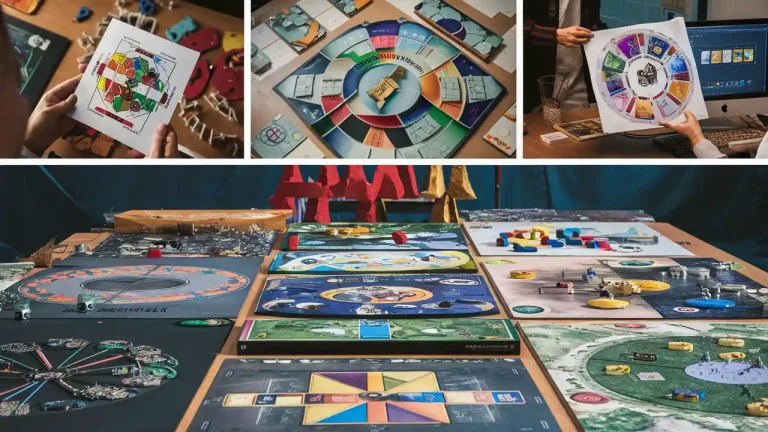
Step 2: Design Your Game Board
Now it’s time to create the game board itself.
Here are some popular board layouts:
- Linear track (like Candy Land or Chutes and Ladders)
- Circular path (like Monopoly)
- Branching paths (giving players choices)
- Grid layout (like chess or checkers)
For beginners, I recommend starting with a simple linear or circular path.
方法如下:
- Draw the basic path on your cardboard using pencil first
- Divide the path into squares or spaces (at least 30 for a good game length)
- Trace over your pencil with marker
- Color code different spaces (some blue, some red, some green, etc.)
- Add special spaces (shortcuts, penalty spaces, bonus spaces)
- Decorate the board with images related to your theme
Remember to mark clear “Start” and “Finish” spaces!
Step 3: Create Game Cards and Rules
Board game crafts for kids are more engaging when there are challenges along the way.
Create different card categories like:
- Action cards (Do 5 jumping jacks!)
- Question cards (educational questions)
- Challenge cards (Draw with your eyes closed)
- Bonus cards (Move ahead 3 spaces)
- Penalty cards (Go back 2 spaces)
Write the rules of your game. Keep them simple for younger kids, more complex for older ones.
Basic rules might include:
- Roll the dice to move
- Land on a colored space? Draw a matching card
- Follow the instructions on the card
- First player to reach the end wins
Pro Tip: Test play your game before finalizing the rules. You’ll quickly see what works and what needs adjusting.
Making Your Board Game Educational
Here’s where DIY board games really shine over store-bought ones.
You can easily incorporate learning into your custom board games:
- Math skills: Include counting, addition, or multiplication challenges
- Language arts: Add spelling words or reading comprehension questions
- Science: Include fact cards about animals, planets, or experiments
- Geography: Create challenges about states, countries, or landmarks
- Problem-solving: Design puzzles that must be solved to advance
For example, I once helped a family create a “Times Table Trek” game where kids had to correctly answer multiplication problems to move ahead. Their 8-year-old’s math scores improved within just a month of playing regularly!
Age-Appropriate Board Game Activities
Different ages need different types of board games:
Ages 3-5:
- Simple paths with 15-20 spaces
- Picture-based instructions
- Basic counting (move ahead 1-3 spaces)
- Physical actions (hop like a frog, roar like a lion)
Ages 6-8:
- Longer paths with 20-30 spaces
- Simple reading required
- Basic math challenges
- Memory activities
- Creative challenges (draw something specific)
Ages 9-12:
- Complex paths with 30+ spaces
- Strategy elements
- More advanced academic content
- Team challenges
Advanced Board Game Design Tips
Ready to take your homemade board game to the next level?
Try these advanced design tips:
1. Add 3D Elements
Make your board game pop with:
- Small boxes as obstacles
- Clay figurines as custom game pieces
- Folded paper tents as special spaces
- Mini treasure chests holding game cards
2. Create Special Game Pieces
Instead of using boring pawns, create custom game pieces that match your theme:
- Dinosaur figures for a prehistoric adventure
- Rocket ships for a space game
- Different colored gems for a treasure hunt
- Miniature characters with photos of family members
3. Incorporate Digital Elements
It’s 2025, after all! Consider adding:
- QR codes on spaces that link to videos or sounds
- Augmented reality elements using free AR apps
- Digital timers for timed challenges
4. Design Expandable Content
Create your game with expansion packs in mind:
- Leave room on the board for new paths
- Create additional card sets for different skill levels
- Design holiday-themed add-ons
Real-World Board Game Success Stories
I’ve seen some incredible DIY board games over the years. Here are a few that stand out:
The Spelling Safari Created by a mom for her 7-year-old struggling with spelling, this jungle-themed game had players advancing by correctly spelling words. The genius part? She used the child’s actual spelling list from school each week.
Chore Challenge A dad created this game where landing on certain spaces meant drawing a “chore card.” Complete the quick chore (put away 5 toys, etc.) and earn bonus moves. His kids cleaned the entire house while playing!
Math Masters A teacher designed this for her class where different colored spaces corresponded to different difficulty levels of math problems. Kids could choose their challenge level, making it work for mixed ability groups.
Troubleshooting Common Board Game Problems
Even the best board games run into issues. Here’s how to fix the most common problems:
Problem: Kids get bored halfway through Solution: Make sure no player falls too far behind. Add more “catch-up” mechanisms like shortcuts or bonus spaces.
Problem: Game is too easy/hard Solution: Create tiered challenge cards (easy, medium, hard) and let players choose their difficulty.
Problem: Board falls apart during play Solution: Laminate the board or cover it with clear contact paper for durability.
問題:遺失遊戲棋子 解決方案:創造一個屬於遊戲的儲存容器 (寶箱、太空船等),並讓收起碎片成為遊戲結束的一部分。
Making Board Games a Regular Family Activity
製作 DIY 桌遊不應該是一次性的活動。以下是如何讓它成為家庭文化的一部分:
- 舉辦每月一次的「遊戲創作日」,讓大家設計迷你遊戲
- 為不同的節日製作季節性遊戲
- 挑戰每個家庭成員設計一個遊戲,教授他們擅長的東西
- 在「遊戲設計日記」中記錄您的創作
- 與親朋好友分享遊戲以獲得回饋
根據我的經驗,一起創作遊戲的家庭能建立令人難以置信的創造性問題解決技巧,這些技巧可以轉移到生活的其他領域。
最終想法
學習如何為孩子製作自己的棋盤遊戲不僅僅是一個手工藝項目。這是一種創造客製化學習經驗、建立家庭關係和發展創意思維能力的方法。
最棒的是什麼?不像昂貴的玩具玩不了幾天就會被遺忘,自製的棋盤遊戲所創造的回憶可以持續很多年。
因此,收集您的用品、選擇主題並開始創作!您的孩子會感謝您為他們帶來的樂趣,以及他們在過程中建立的技能。
請記住:最成功的自製桌上遊戲不一定是最漂亮或最複雜的。它們會讓您的孩子說:「我們可以再玩一次嗎?
現在我很想聽聽您的意見:您打算和孩子一起製作哪種 DIY 桌遊?請在留言中告訴我!
 Chinese
  English
  German
  French
  Spanish